


J-PARC News March 2026 (Issue#251)
■Award
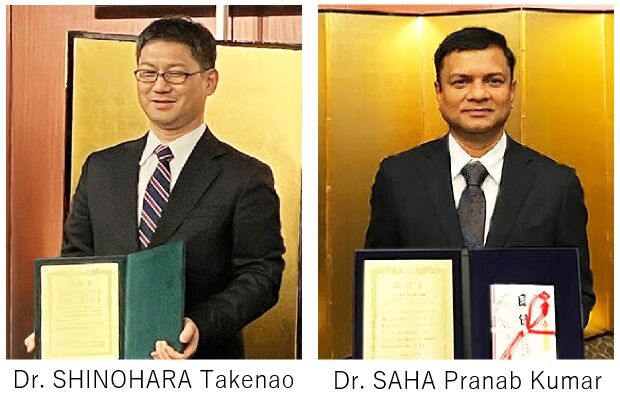
Awarded the 15th High Energy Accelerator Science Research Encouragement Awards: Koshiba Award and Suwa Award (February 27)
Researchers including Dr. SHINOHARA Takenao from the Neutron Science Section were awarded the Koshiba Award, and researchers including Dr. SAHA Pranab Kumar from the Accelerator Division were awarded the Suwa Award.
For more details, please visit the J-PARC website.
(1) Koshiba Award https://www.j-parc.jp/c/en/topics/2026/03/11001784.html
(2) Suwa Awrad https://www.j-parc.jp/c/en/topics/2026/03/11001783.html
 |
■Press Release
(1) Significant Improvement in Proton Conductivity at Intermediate Temperatures by Co-doping with Two Elements - Achieving both higher conductivity than existing materials and high chemical stability - (February 17)
In a hydrogen energy society, which is key to a carbon-neutral future, protonic ceramic fuel cells (PCFCs) and protonic ceramic electrolysis cells (PCECs), which operate at intermediate temperatures of 220-400℃, are attracting attention as next-generation technologies. These devices can efficiently convert hydrogen into electricity. However, it has been difficult to find materials with both high proton conductivity and good chemical stability at these temperatures.
In this study, a new material design called "donor co-doping" was applied to an oxygen-deficient perovskite oxide, BaScO2.5. By adding two donor elements, molybdenum (Mo) and tungsten (W), a new ceramic material, BaSc0.8Mo0.1W0.1O2.8, was discovered. This material exhibits world-leading proton conductivity at intermediate temperatures, along with high chemical stability. Neutron diffraction analysis using the high-intensity total scattering instrument "NOVA" at the Materials and Life Science Experimental Facility (MLF), together with first-principles molecular dynamics calculations, revealed that this material has a high proton diffusion coefficient. In addition, donor co-doping does not cause an increase in the activation energy (proton trapping), which is a problem in conventional acceptor co-doping, and it can maintain a low activation energy.
The proton-conducting material discovered in this study is expected to contribute to distributed energy systems that integrate hydrogen production, storage, and utilization. It is also suitable for long-term operation under practical conditions. In the future, PCFCs and PCECs using this material as an electrolyte will be developed and evaluated, with the aim of achieving lower operating temperatures and higher performance.
For more details (in Japanese only), please visit the J-PARC website.
https://j-parc.jp/c/press-release/2026/02/17001747.html
(2) First Direct Observation of the Charging Mechanism in Next-Generation Sodium-Ion Batteries - Revealing the mystery of hard carbon through multi-scale observation using neutron scattering - (February 27)
Sodium-ion batteries (NIBs), which are low-cost and sustainable alternatives to lithium-ion batteries, are attracting attention. For their wider use, it has been important to understand how sodium is stored in hard carbon, a material used for the negative electrode--specifically, where it accumulates and in what order.
In this study, the neutron small- and wide-angle scattering instrument "TAIKAN" at the MLF was used to observe how sodium moves inside the battery during charging. The behavior was observed simultaneously across multiple scales, from the mesoscale (less than about one-thousandth of a millimeter) to the atomic scale (about one ten-millionth of a millimeter). The results showed that sodium is stored in three steps: adsorption on the surface, insertion between layers, and filling nanoscale pores. In addition, theoretical calculations supported that the structural changes in the carbon layers observed in the experiment are reasonable.
This study clearly revealed the sodium storage process in hard carbon through multi-scale observations. These findings provide useful guidelines for designing sodium-ion batteries and are expected to accelerate the development of low-cost and sustainable energy storage systems that do not rely on lithium, as well as long-life and highly reliable next-generation batteries.
For more details (in Japanese only), please visit the J-PARC website.
https://j-parc.jp/c/press-release/2026/02/27001759.html
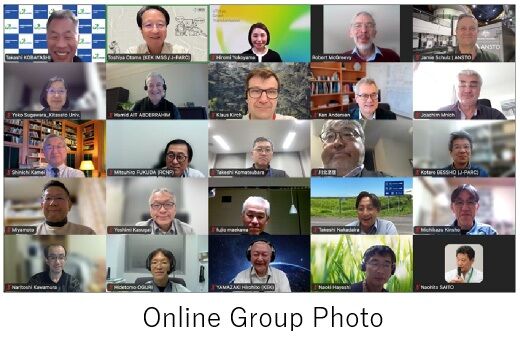
■International Advisory Committee (IAC 2026) Held Online (March 9, 10, and 17 at J-PARC)
The IAC was established under the "Fundamental Collaboration Agreement Regarding the Management of High-Intensity Proton Accelerator Facilities" and serves as a committee in which domestic and international experts deliberate on important matters concerning the operation, user access, and facility development of J-PARC. The committee, consisting of 16 members (12 from abroad and 4 from Japan), which is led by the Chair (Science & Technology Facilities Council, UK), submitted recommendations regarding J-PARC's management, operations, and R&D activities for fiscal year 2025. While J-PARC possesses technical superiority, structural challenges such as financial constraints, human resource issues, and aging infrastructure have become apparent, raising questions about the facility's sustainability.
The J-PARC Center takes these recommendations seriously and will work to improve its future management, operations, and business activities.
 |
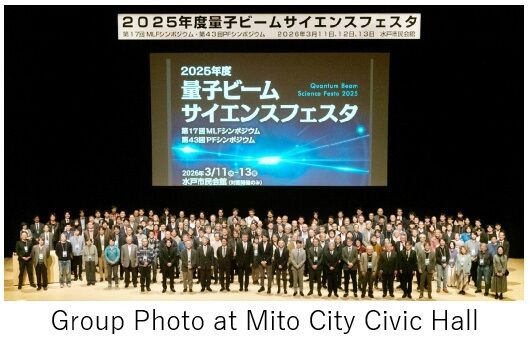
■Quantum Beam Science Festa 2025 Held (March 11-13, Mito City Civic Center)
The 17th MLF Symposium and the 43rd PF Symposium, known as the Quantum Beam Science Festa (QBSF), provide a place for researchers to connect across different probes, including synchrotron radiation, neutrons, muons, and positrons, at the Photon Factory (PF) of KEK and the MLF of J-PARC. The event is held alternately in Tsukuba and Mito each year, and 607 participants registered this year.
At QBSF, the PF Symposium was held on the first day, followed by keynote lectures, poster presentations, and parallel sessions on the second day, and the MLF Symposium on the third day. A total of 227 posters were presented, including 63 entries for the Student Encouragement Award. Three MLF users received awards, and the award ceremony was held during a reception attended by more than 150 participants.
At the MLF Symposium, research results from MLF were mainly presented. In addition, future plans were discussed at the 2nd Roadmap Workshop, a satellite event held on the following day.
 |
■J-PARC Hello Science
Next-Generation Radiography Using Neutrons (February 27)
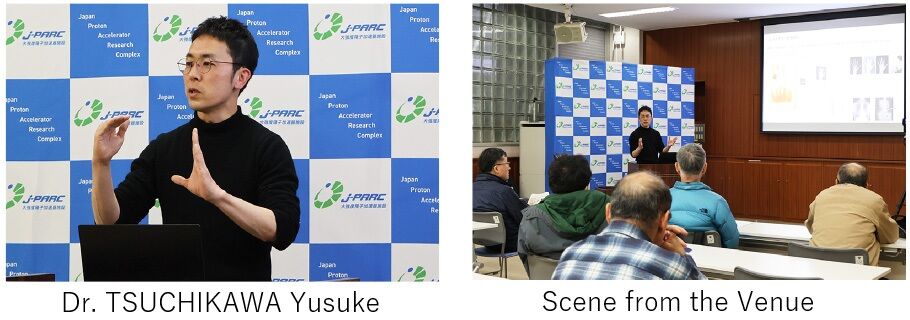
Dr. TSUCHIKAWA Yusuke of the Materials and Life Science Division introduced "neutron imaging," a technique used to observe the inside of objects using neutrons.
One of the major features of neutron imaging is its capability to perform non-destructive measurements, which is difficult to achieve with X-rays. For example, it allows us to observe the movement of water inside metal containers. It can also reveal what elements are inside an object, in what state, and how much is contained. By taking many images while rotating the sample little by little, it is possible to reconstruct the internal structure in three dimensions.
At the MLF of J-PARC, pulsed neutrons are generated every 0.04 seconds. By measuring the arrival time of neutrons that have passed through the sample at a two-dimensional detector, it is possible to analyze the energy spectrum of neutrons at each pixel with very high accuracy. The results obtained at MLF are used in many fields, such as decommissioning research through investigations of reactor structures, non-destructive elemental analysis of cultural properties, and research on battery materials and new functional materials.
 |
■Sakurie Science Festival (March 14, Hitachi Civic Center Science Museum)
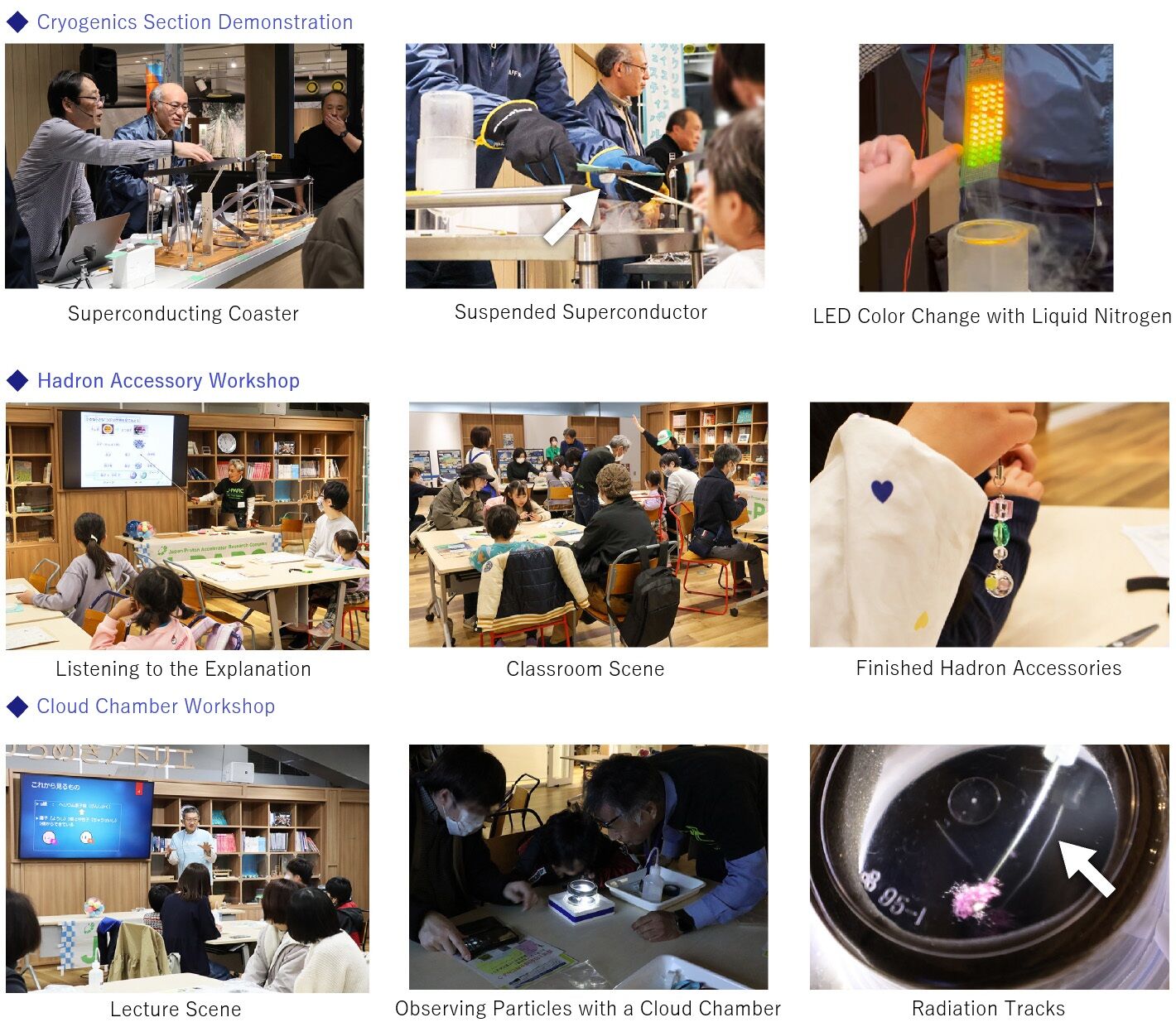
At the science festival, the J-PARC Center held workshops on hadron accessories and cloud chambers, and demonstrations and hands-on activities of a superconducting coaster. The hadron accessory workshop was very popular, and queue tickets for each session were quickly taken. In the cloud chamber workshop, all participants were able to observe the tracks of radiation.
During the superconducting coaster demonstration, many children listened carefully to explanations about extremely low temperatures and superconductivity. At the hands-on booth, many people from children to adults enjoyed running the coaster and trying simple experiments to learn about the properties of superconductors.
They also experienced unique experiments using liquid nitrogen, such as making a light bulb glow brighter by cooling a wire, and changing the color of an orange LED to green when cooled with liquid nitrogen, which was unveiled for the first time at this event.
 |
■J-PARC Outreach Lecture
(1) Kojima Children's Science Park, Tochigi Prefecture (February 21)
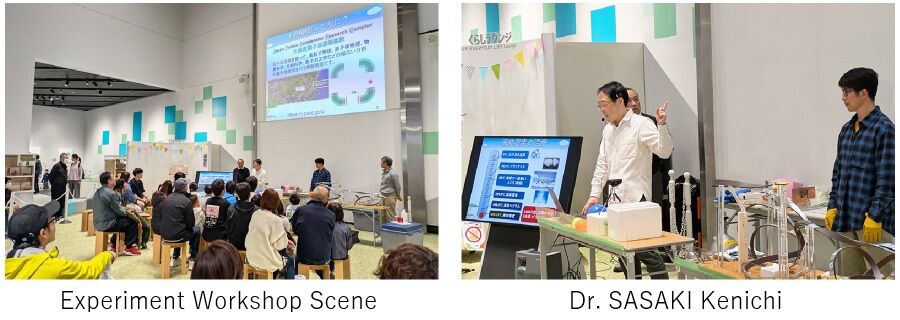
Superconducting coaster workshops have previously been held at various locations. Following one such event, Kojima Children's Science Park asked us to hold an experiment class for elementary and junior high school students at the Kurashi Lounge. This museum was renewed in October last year. It has many hands-on exhibits, and it is a popular place with about 4,000 to 5,000 visitors on weekends.
Dr. SASAKI Kenichi from the Cryogenics Section was the instructor. He held two classes, one in the morning and one in the afternoon. The class included quizzes such as "What happens when we cool a balloon or a rubber ball with liquid nitrogen?" Participants experienced a superconducting coaster and closely observed that a magnet ring rolls down more slowly when it passes next to a cooled copper plate.
 |
(2) Ishigami Elementary School (Thursday, February 26, 2026)
The MLF Outreach Group "Protons" delivered a special outreach class for approximately 30 fourth-grade students. This class was conducted as a joint program with the Tokai Village Museum.
The lesson focused on the theme, "The first step in research is careful observation," and included two activities: "Let's Observe Daphnia, the Masters of Swimming!" and "Dissecting Dried Sardines."
In fourth-grade science, students study the structure of the human body in the unit "Our Body and Movement." In this class, students observed the movements of Daphnia using microscopes and examined the anatomical features of dried sardines using magnifying glasses. Through these hands-on activities, they learned about "life" by exploring the structure of living organisms. Many students actively asked questions, making the class highly engaging and meaningful.
This outreach lecture was supported in part by the KEK Mirai Fund program, "Sowing the Seeds of Science for the Next Generation from J-PARC."
For more details (in Japanese only), please visit the J-PARC website.
https://www2.kek.jp/kff/
 |
■Muographic Investigation of Ancient Burial Mounds in Tokai: Summary of Activities in 2025 (Tokai Village Museum, March 15)
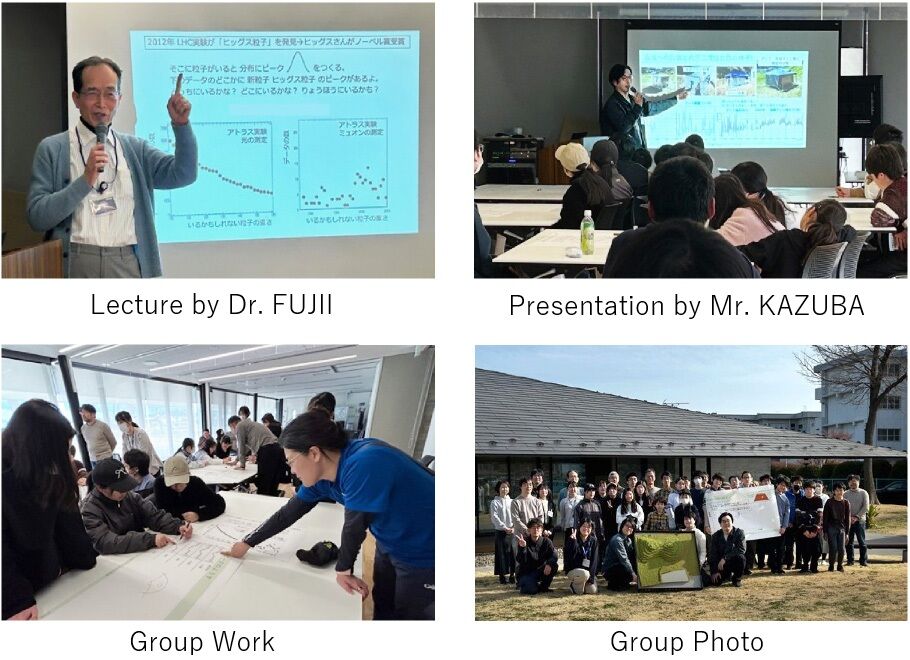
The final activity of FY2025 was held with 19 participants on March 15. First, Dr. FUJII from J-PARC gave a lecture titled "Can you find the Nobel Prize peak?" Participants looked at data from the 2012 LHC experiment, where the Higgs boson was discovered, and worked in groups to identify which peak corresponded to the Higgs boson. Through this activity, they learned that "peaks have meaning."
After that, Mr. KUZUBA from Ibaraki University reported on the analysis of data from the first detector measurement device installed at the Detector for History and Future No. 2 on October 13, 2024. Participants also worked in groups to examine the data and discussed possible locations of cavities (stone chambers). As a result of the analysis, three possible cavity areas were identified at this stage.
While measurements with the first detector continue, the second detector was installed on November 16, 2025, and the data has been steadily collected. The second detector device observes from a direction almost perpendicular to the first one, so analyzing this data may help identify the exact locations of the cavities.
The Muographic Investigation of Ancient Burial Mounds in Tokai will continue its activities next year. Updates will be shared as further analysis results of the burial mound have become available.
 |
■J-PARC Sanpo-michi 68: 15 Years of Recovery and Progress
Visitors who come to J-PARC for the first time often say that it looks like a huge factory. In fact, the facilities are built with extremely high precision. The position of beamline components is controlled within 0.1 mm. For example, to keep the 330 m-long linac tunnel straight, its center must be about 2 mm lower than both ends, assuming they are at the same elevation. This is because the Earth is round, and a completely level structure would not be straight.
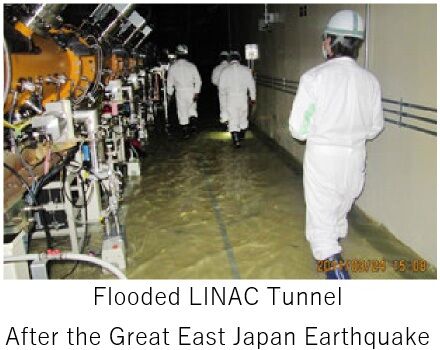
During the Great East Japan Earthquake 15 years ago, Tokai Village was hit by strong shaking (seismic intensity 6−), and J-PARC was seriously damaged. In the linac tunnel, more than 10 cm of groundwater collected, reaching about 100 tons in total. Inside the tunnel, there was no power, and the water was strongly alkaline (pH 11). It was treated with sulfuric acid and then removed in very humid conditions. Another major challenge was restoring the beam path. Due to the strong shaking, the tunnel was deformed, and in some places the linac subsided by up to 43 mm compared to before the earthquake. Such large deformation made it difficult to realign the magnets and restore a straight beamline. Instead, a new beam path with a slight bend was introduced to follow the deformation of the floor. As a result, the linac successfully resumed beam operation on December 9, eight months after the earthquake.
Even today, the proton beam path in the linac remains slightly V-shaped. However, the beam power at MLF has increased from 200 kW before the earthquake to 1,000 kW today.
 |