


J-PARC News February 2026 (Issue#250)
■Start of the Stable User Operations at 900 kW in the MR
Stable user operation at a beam power of 900 kW has been continuously maintained in the Main Ring (MR) accelerator since January 27. Toward the Hyper-Kamiokande experiment scheduled to start in 2028, the beam power upgrade will continue step by step with the goal of achieving 1.3 MW operation.
For more details (Japanese only), please visit the J-PARC website.
https://www.j-parc.jp/c/en/topics/2026/02/03001734.html
■Award
(1) The 31st Outstanding Paper Award of the Physical Society of Japan (January 16)
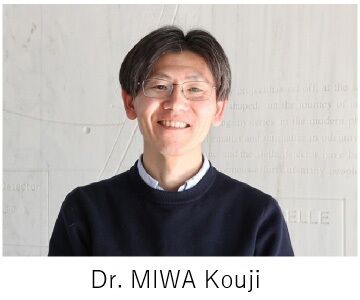
The J-PARC E40 Experiment Group, including Prof. MIWA Kouji of the Graduate School of Science, Tohoku University, and a specially appointed professor at the High Energy Accelerator Research Organization (KEK), and Dr. NANAMURA Takuya, Assistant Professor at the Graduate School of Science, Tohoku University, received the 31st Outstanding Paper Award of the Physical Society of Japan.
Through experiments using a scattering-particle detector operating under J-PARC's high-intensity beam conditions, the E40 Experiment Group successfully detected elastic scattering events between Sigma (Σ) particles and protons with more than 100 times higher statistics than previously achieved. Since scattering experiments using extremely short-lived Σ particles are very challenging, this result represents a major breakthrough. In addition, the group revealed for the first time in the world that the strong repulsive force predicted by quark-model theories of baryon-baryon interactions does not appear as prominently as suggested by theory.
This research established a new experimental technique for hyperon-proton scattering. It was highly evaluated as an important contribution to understanding hyperon-nucleon interactions and as a result that will greatly contribute to future developments in nuclear physics.
 |
(2) The 7th Fumiko Yonezawa Memorial Award of the Physical Society of Japan
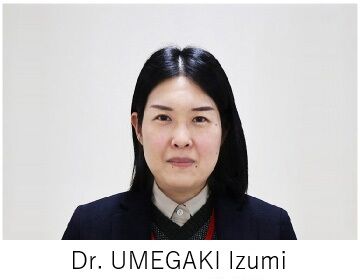
Dr. UMEGAKI Izumi of the Muon Science Section, Materials and Life Science Division, has been awarded the 7th Fumiko Yonezawa Memorial Award.
Dr. UMEGAKI has conducted pioneering research on advanced analysis of lithium-ion batteries using muons, making significant contributions to the advancement of muon science.
For more details (Japanese only), please visit the KEK IMSS website.
https://www2.kek.jp/imss/news/2026/topics/0224JPSJ-Yonezawa-Awd/
 |
■The 20th Tokai Forum Held (February 18, Tokai Cultural Center)
The Japan Atomic Energy Agency (JAEA) holds the Tokai Forum every year as part of its annual activity report to help local residents understand its activities in the Tokai village. This year marks the 20th anniversary of JAEA's establishment. A total of 127 people attended the forum on-site, while 111 people watched the event online.
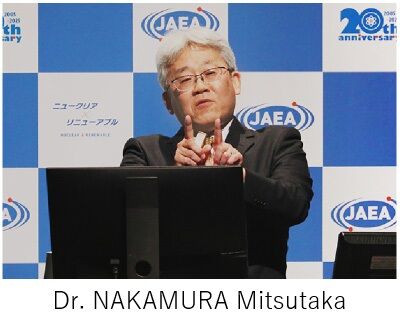
At the forum, the activities of the Nuclear Fuel Cycle Engineering Laboratories, the Nuclear Science Research Institute, and the J-PARC Center were reported. Dr. NAKAMURA Mitsutaka of the Materials and Life Science Division, J-PARC Center, gave a presentation titled "The Power to Shape the Future: Challenges of the MLF Neutron Instruments," reporting on neutron utilization research conducted at the Materials and Life Science Experimental Facility (MLF). The presentation introduced the world's most intense neutron beam provided by the MLF and neutron instruments designed to maximize the unique properties of neutrons. These instruments enable rapid and detailed observations of light elements and structural analyses of materials.
For more details (Japanese only), please visit the following website.
https://www.jaea.go.jp/04/ztokai/forum/
 |
■J-PARC Hello Science
From Hospitals to Artworks: Surprising Places Where Accelerators Are Used (January 30)
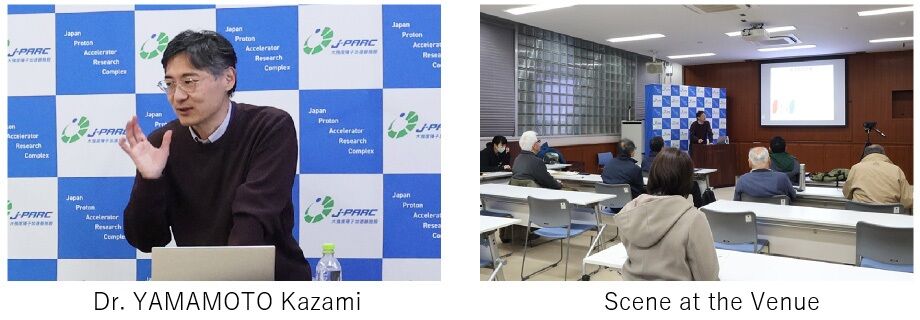
Dr. YAMAMOTO Kazami of the Accelerator Division introduced various accelerator technologies used in daily life.
An accelerator is a device that accelerates charged particles, such as electrons and protons, to high energies. At J-PARC, three accelerators are combined to generate a high-intensity proton beam.
Particles produced from the proton beam--such as neutrons, muons, neutrinos, and mesons--are used to study the inside of objects nondestructively and to investigate phenomena related to the origin of the universe.
When people hear the word "accelerator," they may imagine a huge device in a special research facility. However, accelerators are actually used in many familiar places. In the medical field, accelerators are used to generate X rays for diagnostic imaging and radiation therapy, and to deliver accelerated particle beams directly for treatment. X-rays produced by accelerators are also used for baggage screening at airports. In addition, cathode-ray tube (CRT) televisions, once common in many households, used an accelerated electron beam directed at the screen to produce light. Accelerators are also used in various other fields, such as quality control in the food and agricultural industries, and in semiconductor manufacturing.
Accelerator technology is not limited to research. It is an important technology that supports society, and it is expected to play an active role in many more fields in the future.
 |
■J-PARC Outreach Lecture
(1) Yokoshibahikari Town Community Center, Sambu District, Chiba Prefecture (January 17)
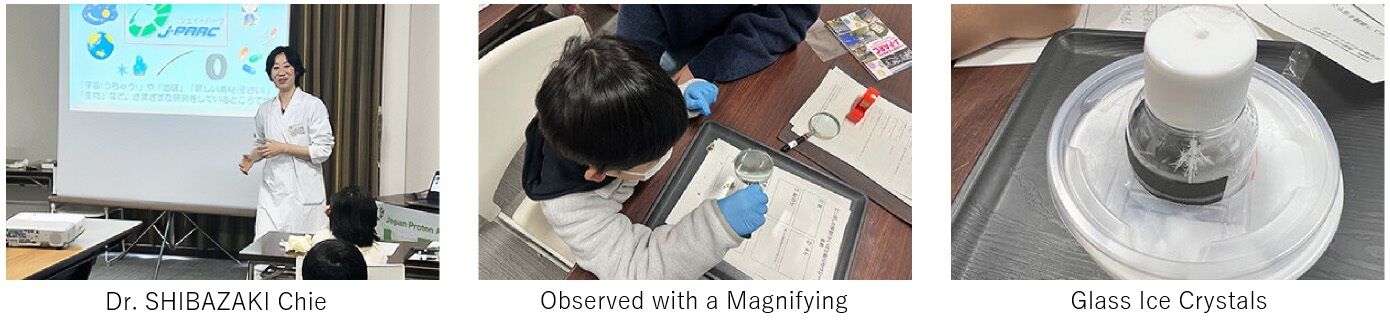
As part of the Parent and Child Challenge Seminar "Enjoyable Science Experiment Class," an experimental workshop was held with the theme of "Dissection of Dried Sardines" for lower-grade elementary school students and "Let's Observe Snow Crystals" for upper-grade students.
The class was conducted by Dr. SHIBAZAKI Chie of the MLF Outreach Circle "Protons" (Technology Development Section).
On the day of the event, participants observed dissected dried sardines and ice crystals carefully using magnifying glasses, under the slogan, "The first step in research is to observe closely with your own eyes."
Many impressions and questions were shared by the participants, such as: "I observed dried sardines and now I would like to observe more living things around me," "I was surprised that the brain and heart are only about 5 millimeters in size," "What is the function of fish gills?" and "Does the shape of ice crystals change depending on how they are cooled? I would like to learn more about why water expands when it freezes."
Through these activities, the class successfully encouraged participants' interest in science.
 |
(2) Muramatsu Elementary School, Tokai Village (January 27)
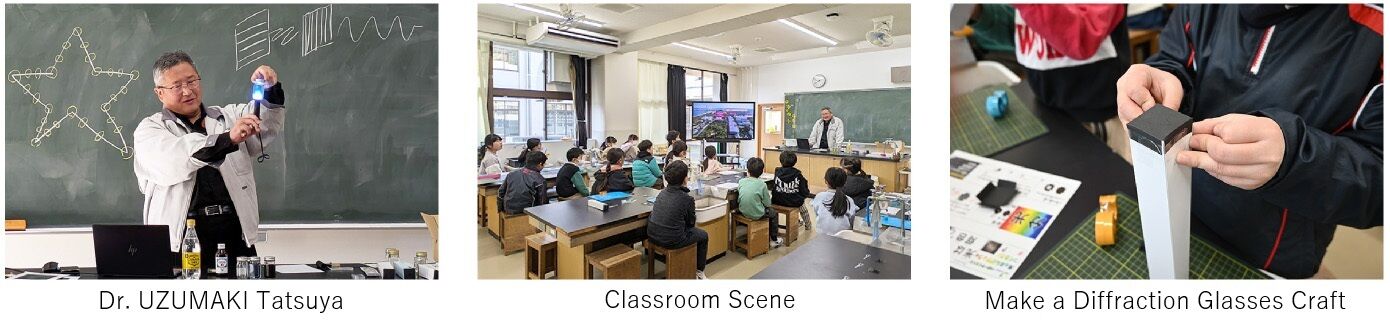
A hands-on workshop titled "Light Kaleidoscope" was held for third-grade students by Dr. UZUMAKI Tatsuya from the Public Relations Section.
During the session, students explored various optical phenomena, such as observing how liquids change color when illuminated with a black light, and how the appearance changes when two polarizing sheets are layered and one sheet is rotated. They also experienced the fascinating effects of light polarization firsthand.
In the final activity, the students created their own kaleidoscopes using diffraction grating sheets. By looking through their kaleidoscopes, they were able to see rainbow-colored light, and many students appeared very satisfied with the experience.
The school principal also observed the workshop and expressed interest in inviting the program again next year, commenting, "We would love to have this workshop again next year.
 |
(3) Nagi Junior High School, Nagi Town, Okayama Prefecture (February 6)
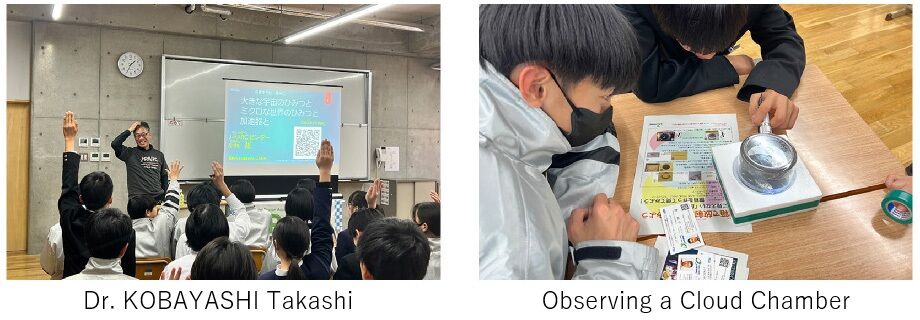
A special outreach class titled "The Mysteries of the Vast Universe, the Microscopic World, and Accelerators" was delivered on February 6 by Dr. KOBAYASHI Takashi, Director of the J-PARC Center.
The program was designed to encourage students to learn actively while enjoying the experience. In addition to a lecture, the class included a question-and-answer session and group work using a cloud chamber experiment. Participating students asked questions such as "How was the universe created?", "What triggered the formation of the Earth?", "Why does fog form inside the cloud chamber?", and "Why do these results occur?", and engaged in lively exchanges of opinions with Dr. KOBAYASHI.
The class was a meaningful opportunity for students to think independently rather than leaving mysteries unexplored, starting from familiar questions of "why?" and "how?".
Through their surprise and excitement during the experiments, the class also helped spark their interest in science.
 |
■Visitors
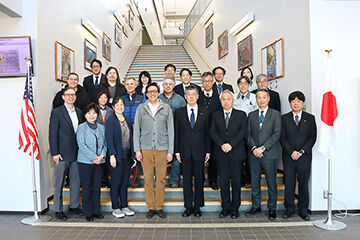
Senior officials from the U.S. Department of Energy, including Dr. Darío Gil, visited J-PARC.
For more details (Japanese only), please visit the J-PARC website.
https://www.j-parc.jp/c/en/topics/2026/02/04001730.html
 |
■J-PARC Sanpo-michi 67: Reflections in a Convex Traffic Mirror
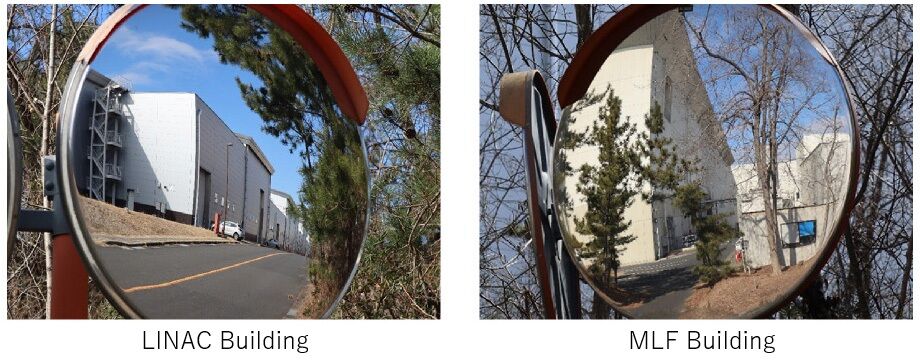
The roads connecting the various facilities at J-PARC have many curves, and several convex traffic mirrors have been installed to improve visibility. These mirrors reflect a wide area and help reduce blind spots for drivers. On the other hand, because objects appear smaller than they actually are, cars or pedestrians may look farther away than they really are.
The photos show the LINAC Building and the MLF Building reflected in convex traffic mirrors near each facility. The LINAC Building is about 330 m long, about the length of Tokyo Tower laid on its side. For this reason, the entire building cannot be captured in the mirror, even when the viewing angle is changed. In contrast, the MLF Building is about 150 m long and 70 m wide, and it has a volume large enough to hold two jumbo jets if the inside were hollow. Even so, only part of the building can be seen in the mirror.
The buildings at J-PARC are so huge that they cannot fit completely even in mirrors designed to reflect a wide area. In the mirror, gentle winter sunlight under a blue sky can be seen casting a faint shadow on the white buildings.
 |