


"J-PARC Outreach Lecture" held in May 2025
◆◇◆ National Institute of Technology, Tsuyama College (Thursday, May 1, 2025) ◆◇◆
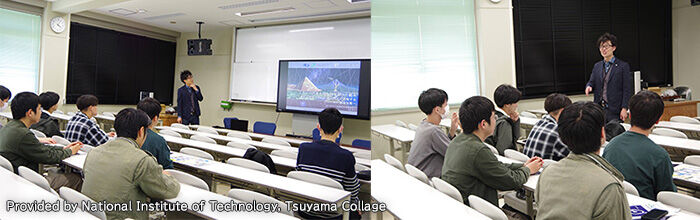
Dr. OTANI Masashi from the Accelerator Division delivered a lecture titled "How Accelerators Reveal the Microscopic World - Muon Acceleration Technology for Probing from Subatomic Phenomena to Massive Structures" for third- and fourth-year students at the National Institute of Technology, Tsuyama College.
In the lecture, he explained the principles of particle accelerators and introduced their wide-ranging applications in fields such as industry and medicine.
He then discussed muons-subatomic particles used to discover hidden chambers in ancient pyramids and to visualize the interior of volcanoes. He also introduced research conducted at J-PARC using artificially generated high-intensity muons, as well as the latest developments in related technologies.
Toward the end of the lecture, he presented a case study on a collaborative project involving students building a compact accelerator named AxeLatoon (a coined term combining "Accelerator" and "Ratoon," meaning new sprout), as part of a community engagement initiative.
A Q&A session was held before and after the lecture, during which students asked questions not only about heavy-ion cancer therapy featured in the lecture but also about other medical applications and what research life is like at KEK ( High Energy Accelerator Research Organization) and J-PARC.
These exchanges revealed that many students were inspired to consider future careers in accelerator-related fields, indicating that the lecture served as strong motivation for their career planning.
 |
◆◇◆ Koka Gakuen Junior and Senior High School (Wednesday, May 7, 2025) ◆◇◆
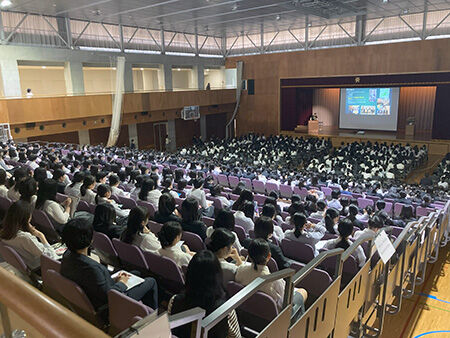
Approximately 900 female students, ranging from the first year of junior high school to the third year of high school, attended a lecture presented by Director KOBAYASHI Takashi and Dr. SHIBAZAKI-FUNYU Chie from the Technology Development Section. Dr. SHIBAZAKI, an alumna of Koka Gakuen who attended the school from kindergarten through high school and later taught science there for seven years after graduating from university. Her talk began with fond memories of her time as a student, followed by insights from her experience as a science teacher and the inspiration that led her to pursue a research career. She concluded by introducing her current work on determining protein structures using neutron crystallography. Following her presentation, Director Kobayashi provided an overview of J-PARC and introduced cutting-edge research related to the universe and life sciences.
After the lecture, the students asked a variety of questions and shared creative ideas that reflected their curiosity about science. These included, "Do aliens exist?," "If we were to artificially create a Big Bang, where would be the best place to do it?," and "What if we wove long molecules to create spider silk like in Spider-Man?" Interestingly, in a survey asking which topic interested them the most, the top response was "Women's careers and life paths," reflecting the unique perspective of an all-girls school. Notably, while over 90% of the students had never heard of J-PARC before the lecture, more than 80% responded that they became interested in it afterward - a clear sign that the lecture made a strong impact.
 |
◆◇◆ Suwa Elementary School in Hitachi City (Tuesday, May 13, 2025) ◆◇◆
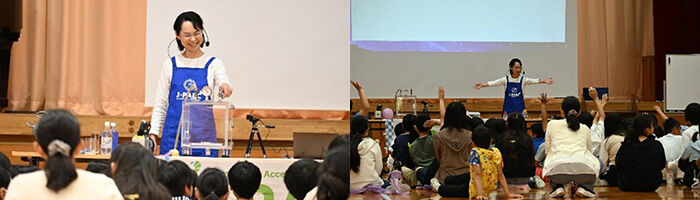
The class, titled "Let's Explore the Invisible Vacuum," was conducted for 80 fifth and sixth-grade students at Suwa Elementary School, operated by the City of Hitachi. It was organized as part of a science program by the Hitachi Civic Center, with Ms. MOROHASHI Yuko from the J-PARC Center Accelerator Division serving as the instructor.
Using well-known items such as balloons, hot water, and marshmallows, the vacuum experiments captivated the students, who cheered with excitement each time a visible change occurred.
Students and teachers shared their impressions, saying things like:
"The vacuum cannon was so powerful, it surprised me!"
"It was fascinating to see the water drawn into the cup-it was mysterious and fun."
"It was a great experience to witness phenomena I had only seen in textbooks."
 |
◆◇◆ Open University of Japan - Library Lecture Series (Saturday, May 17, 2025) ◆◇◆
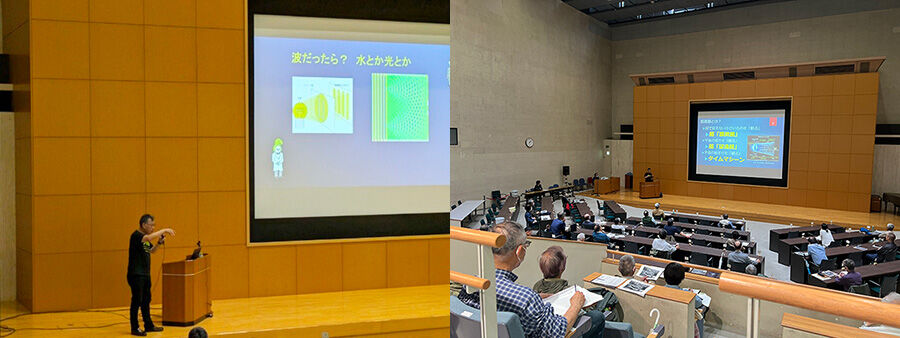
As the first lecture in JFY2025 of the "Library Lecture Series" hosted by the Ibaraki Learning Center of the Open University of Japan, Director KOBAYASHI Takashi delivered an engaging lecture titled "Exploring the Origins of the Universe and Matter with J-PARC, the World's Most Powerful Accelerator at Ibaraki" at the Ibaraki Prefectural Library. He explained the research conducted at J-PARC in an accessible and easy-to-understand manner. More than 50 participants attended the event, listening attentively and taking notes throughout the lecture.
After the lecture, participants asked questions such as, "How can we distinguish between neutrinos and antineutrinos? "and "How are neutrinos from space differentiated from those coming from J-PARC when detected in Kamioka?" Pointing to the materials projected on the large screen, Director KOBAYASHI responded, "Antineutrinos have the opposite spin orientation," and added, "Since the emission time of neutrinos from J-PARC is precisely measured, we can also determine their arrival time in Kamioka.
 |