


"J-PARC Outreach Lecture" held in February 2025
◆◇◆ Katsuta Third Junior High School, Hitachinaka City (Tuesday, February 4, 2025) ◆◇◆
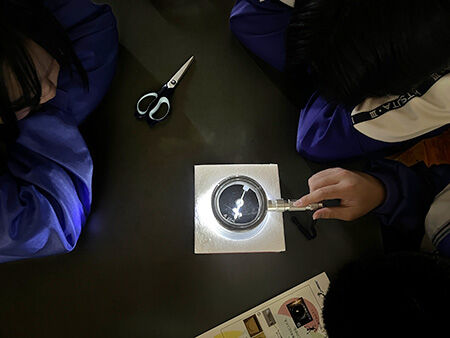
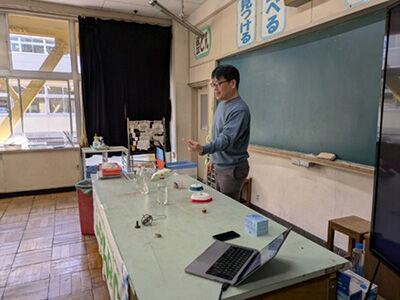
A lecture and workshop to build a "cloud chamber" was held for about 120 students in four ninth grade classes to deepen their understanding of basic knowledge related to space, energy and radiation.
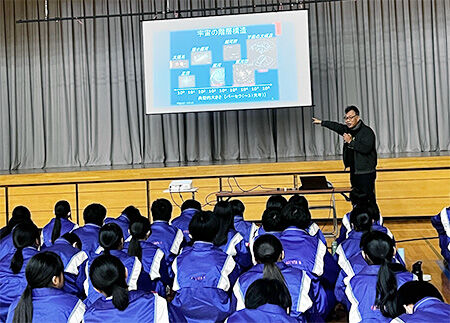
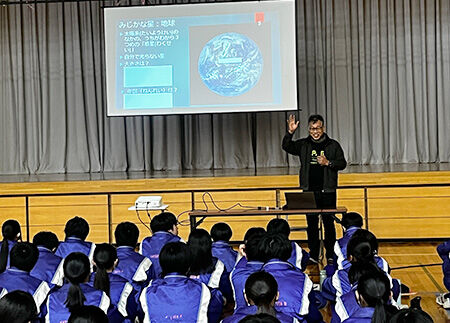
First, Dr. KOBAYASHI Takashi, Director of the J-PARC Center, gave a lecture on the theme "Secrets of the Big Universe, Microscopic World and Accelerators", in which he talked about the size of the universe and the smallness of the microscopic world, and also about the research being conducted at J-PARC on space, elementary particles and accelerators, sometimes based on his own experiences.
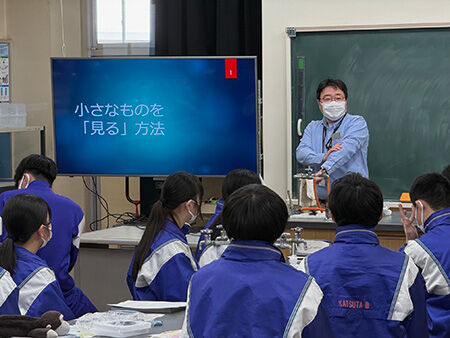
Next, in the theme "How to 'see' small things" by Mr. TAKAHASHI Kazutoshi, Radiation Control Section, gave a presentation. The students challenged to make a "cloud chamber" through group work, which allowed alpha radiation to be visualized in supersaturated ethanol.
 |
 |
 |
 |
◆◇◆ Shirakata Elementary School, Tokai-Village (Friday, February 7, 2025) ◆◇◆
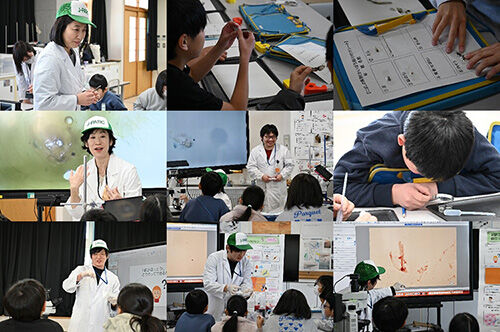
The ※MLF Outreach Circle 'Protons' gave classes and guided observations for approximately 80 students from three fourth-grade classes. The theme was 'You are a researcher, too! Let's observe creatures of various sizes.'
With the slogan "The first step in research is to look closely!" the children challenged three themes: (1) dissecting dried sardines, (2) looking at the swimming masters, water fleas, and (3) the secrets of natto.
Observing the creatures around us with magnifying glasses and microscopes can lead to new discoveries. Dr. Shibazaki, the leader of this outreach class, sent a message to the students as below.
"It is important to think that science is fun! I would be happy if you include 'researcher' as your potential future career."
※ MLF=Material and Life Science Experimental Facility
 |
◆◇◆ Takuma Campus, National Institute of Technology, Kagawa College (Tuesday, February 18, 2025) ◆◇◆
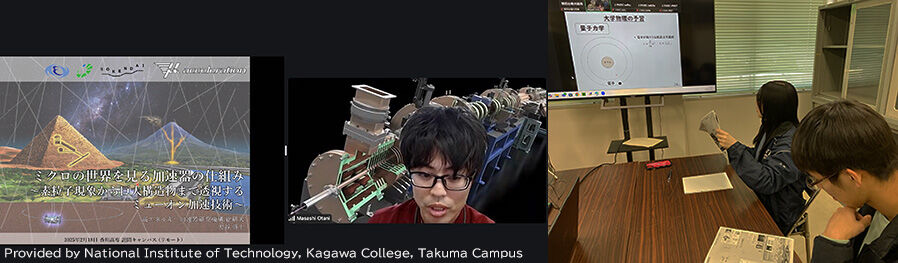
Dr. OTANI Masashi of the Accelerator Division gave an online lecture titled "The Mechanism of Accelerators that View the Microscopic World: Muon Accelerator Technology that Views Everything from Elementary Particle Phenomena to Giant Structures" at Takuma Campus of National Institute of Technology, Kagawa College. Dr. OTANI has succeeded in accelerating elementary particle muons for the first time at J-PARC and is using the accelerator to explore the mysteries of muons, while also developing new inspection technology using the accelerated muon beam.
In the lecture, he explained the structure and principles of accelerators and, as an example of their use, he introduced medical applications, which are of great interest to students. Furthermore, he introduced industrial applications of muons, such as research into the interior of ancient pyramids and magma in volcanoes, and the commercialization of a device to monitor contraband in containers at ports, making use of the penetrating power of muons. In the last part of the lecture, Dr. OTANI, who is a graduate of a technical college, introduced his own experiences in social cooperation projects, the production of a small accelerator, ~AxeLatoon,~by students at the technical college.
In the post-attendance questionnaire, we received comments such as "I would like to know more about the mechanism and origins of accelerators," "I would like to hear more about why you studied accelerators and the interesting aspects of accelerators," and "I would like to hear about simulations of accelerators."
 |
◆◇◆ Katsukura Elementary School, Hitachinaka City (Wednesday, February 26, 2025) ◆◇◆
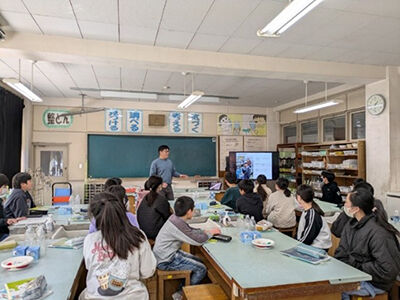
Dr. MIBE Tsutomu of the Hadron Section gave a special class on "How to make a mysterious top that tilts but doesn't fall over⁉."
He asked the students questions such as "What is the smallest thing in the world?" and "What is made a lot in Ibaraki Prefecture? ". He explained that J-PARC is a facility where they study elementary particles by creating lots of them. Although they are so small that they are invisible to the eye, they move like tops. The sixth graders observed the rotation of the axis of the Gyroscope, and each made their top and conducted an experiment to change the direction of the rotation of the axis by changing the center of gravity of the top.
 |
 |